



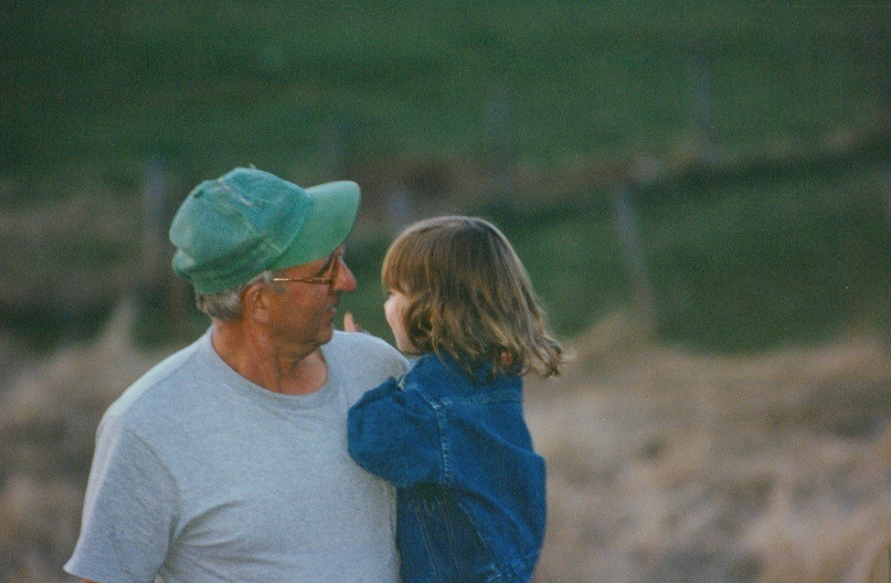
Last weekend, we buried my grandpa, Aaron Eckel, in the fertile sandy soil of the family cemetery, amongst his relatives dating back to the 1830s. The cemetery is situated between the barn where he raised Holstein cows and the house that he built with his own hands after marrying my grandma, Lila, in 1959. Behind the cemetery is a field where the cows used to pasture, but is now leased for planting. During the funeral, the corn stood sentinel. My grandpa always said that the corn should be "knee-high by the Fourth of July." He would have been pleased by how green and sturdy it is.
I am finding my grief for Grandpa Aaron to be more complicated than it was for my dad's parents. I miss my Grandpa Gene when I think about about singing silly songs around a campfire. I miss my Grandma Mary Ann when I put on a bright color or a chunky earring. I miss both of them especially at Passover. But I don't miss their apartment in New Jersey or their townhouse in North Carolina. I am feeling an extra layer of grief over the place that Grandpa Aaron inhabited. My Grandma Lila still lives on the farm. Little has truly changed. The rug in the living room is the same one that I crawled on in baby pictures. But what is the farm without the farmer? I think the very fact that the place and the people were so consistent is why Grandpa Aaron's absence feels so towering.
Today is Tisha B'Av, the Jewish day of mourning. It commemorates the destruction of both the first and second Temples in Jerusalem, and has come to symbolize all the historical tragedies that have befallen the Jewish people, with events such as the expulsion from Spain in 1492 being ascribed to this date. It is a day of sackcloth and ashes, a day of grieving and yearning for the people and places that will never be the same again. Jewish tradition encourages us to remember, to hold both the pain and the joy, and to keep those who are gone alive in our memories.
This week's Torah portion, Vaetchanan, famously includes a retelling of the Ten Commandments as well as the Sh'ma and V'ahavta that we recite every day. But I am so hung up on the first word of the portion. Vaetchanan – "I pleaded." Moses is reaching the end of his life, a life of hard work and sacrifice and leadership, and he is realizing that he is not going to get everything that he wanted, even after pleading with God. All he wanted was to see the "good land" that he had been guiding the people toward, but God says no. Moses must have been heartbroken. But he still has the strength to continue teaching the people how to live well. He says to them, "You shall love Adonai your God with all your heart, with all your soul, and with all your abundance." Even when your heart is broken, you should use it to love. Even when you are deep in grief, you still have memory and legacy to guide you forward.
My Grandpa was lucky. He lived for 92 and a half years and now he gets to stay on his own "good land" forever. We will miss him tremendously. We are so sad that our pleas for more time with him didn't work. But we are so grateful for who he was and how he lived his life and the love that he shared with us. On Tisha B'Av, we are taught that the destruction of the Temple came because of sinat chinam – baseless hatred- and so our response should instead be ahavat chinam – love that is given freely. So in this season of grieving, I urge you to use your memories of the people and places that live in your heart as seeds to grow more love. Let love be their legacy.
Grandpa holding me

Grandpa working in the family garden with my Uncle Craig & my aunt Barbara, 1964. The cemetery where he is now buried is behind them.