


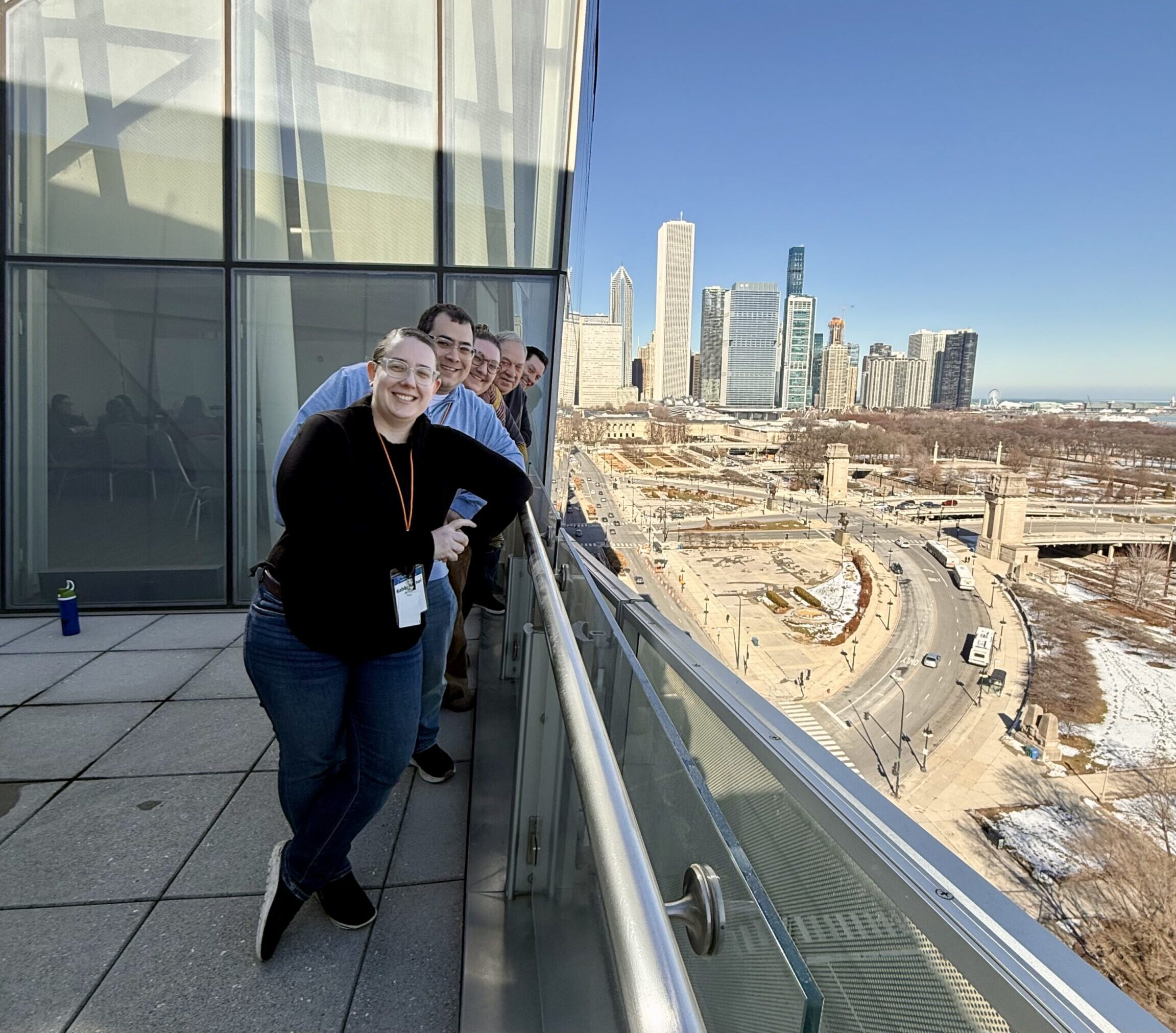
Last week, I had the gift of stepping away from the day-to-day rhythms of Jeremiah life and into something that felt, in its own way, like sacred work. I participated in the first part of the Inaugural Certificate in Israel Leadership program at the Spertus Institute for Jewish Learning and Leadership, and I came home full of learning, questions, and with gratitude.
What made it especially meaningful was that Temple Jeremiah came as a team: Cantor Lianna Mendelson; Danny Glassman, our Executive Director; Matt Rissien, our Director of Congregational Learning; and Jerry Tatar, Vice President and Chair of our Adult Learning Committee. We learned alongside colleagues and congregants from Temple Sholom of Chicago, Temple Beth El in Northbrook, North Suburban Synagogue Beth El in Highland Park, and Or Shalom in Vernon Hills. It was a room full of people who care deeply about the many ways Israel shows up in our congregations and care deeply about community—and who know those two things don't always fit together easily.
Before we discussed policy, politics, or pedagogy, we named the values that would shape our learning space: Vulnerability, Intentionality, Trust, and Awareness—VITA, in Latin meaning "life." It was a reminder that this work is not only intellectual; it is relational. If we're going to talk about Israel in meaningful ways, we have to practice how to stay human with one another first.
We grounded ourselves in Yehuda Amichai's poem, "The Place Where We Are Right," which gently challenges the idea that being "right" is the goal. Amichai suggests that certainty can make us hard and isolated, while doubt and love soften us and create space for connection. That framing carried through the week: less about winning arguments, more about cultivating curiosity.
With Dr. Keren Fraiman and Dr. Dean Bell, we explored the origins of Zionism and the different ideological streams that shaped the founding of the State of Israel—Herzl's political Zionism, Rav Kook's religious vision, A.D. Gordon's labor ideals, Jabotinsky's security focus, Ahad Ha'am's cultural renaissance, Brandeis's diaspora partnership. Seeing those voices side by side reminded us that Zionism has always been a conversation, full of tension and aspiration, long before there was a state.
We studied Israel's Declaration of Independence not only as a political document but as an aspirational text—negotiating competing visions, seeking international legitimacy, and promising democracy and equality even amid existential uncertainty. We wrestled with the boundaries between criticism of Israel and antisemitism, learning how definitions like IHRA and Nexus attempt to provide clarity without collapsing nuance. We explored polarity thinking—how values like openness and safety, love and criticism, hope and reality, complexity and moral clarity must live in conversation rather than competition. And through the lens of adaptive leadership, we were reminded that Israel engagement is not a technical problem to fix with the right statement. It is an adaptive challenge that requires patience, trust, and the courage to sit with discomfort.
One of the most practical sessions was with Gary Susswein, a strategic communications consultant for Jewish institutions. He named what many leaders feel: talking about Israel can get you in trouble, and not talking about Israel can also get you in trouble. His guidance was simple and wise—start with shared identity and shared values. When friction arises, return to those values as your compass.
And this week we study Parashat Terumah.
Terumah is not dramatic. There are no plagues, no splitting seas. Instead, there are measurements. Materials. Instructions. God asks the Israelites to build a Mishkan—"V'asu li mikdash v'shachanti b'tocham," "Make for Me a sanctuary, that I may dwell among them."
What particularly strikes me this year is that the Mishkan is built in the wilderness, at a time when the people are far from settled and far from certainty. They are newly free, still anxious, still arguing. And yet, instead of waiting for clarity or unanimity, God invites them to build. Each person brings what they can "from every person whose heart is moved."
The sanctuary emerges not from agreement, but from shared commitment.
That is what this work around Israel leadership feels like. We are not trying to manufacture uniformity. We are trying to build a communal structure sturdy enough to hold complexity. The values we named—vulnerability, trust, awareness, and intentionality—are our building materials. Our mission and vision are the blueprints. Our red lines are the boundaries that give the structure shape. And our willingness to hold tensions without tearing apart—that is what allows holiness to dwell among us.
This was only the first part of a longer journey. In the months ahead, our Temple Jeremiah team will engage in coaching to help translate this learning into real institutional practice, and we will reconvene in May for the next seminar. Like the building of the Mishkan, this is not a one-day project. It unfolds piece by piece, conversation by conversation.
My hope and prayer is that through this process we will strengthen our capacity to speak, to listen, to disagree, and to remain in relationship. May we build a community spacious enough for multiple truths, strong enough for hard conversations, and grounded enough in our values that holiness can dwell among us.
And may we know that even in complicated times, we are still capable of building something sacred together.