


I like to say that the Torah ends on a cliffhanger.
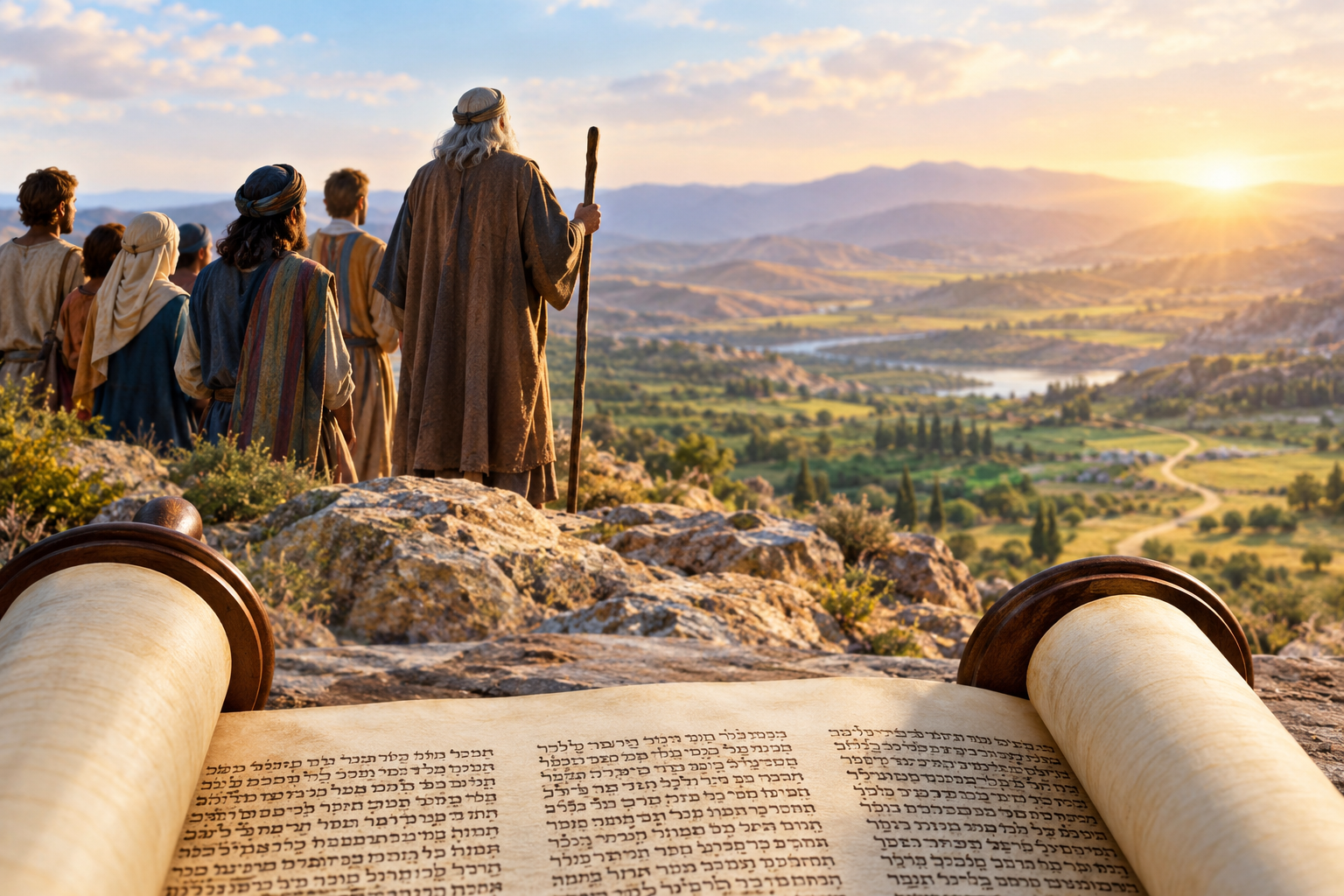
After generations of promises and forty years of wandering, the Israelites are ready to enter the Promised Land. Moses has died. Joshua is their leader. They stand at the border, with a new chapter of their lives waiting just ahead.
And then we roll the scroll back to the beginning.
The story continues in the Book of Joshua, of course. But our annual Torah reading cycle leaves us at that threshold. Before we follow the Israelites into what comes next, we return to the creation of the world. An ending becomes a beginning, with possibility still open before us.
Just before this ending, Moses offers his final blessings to the tribes. His words echo another farewell: Jacob's blessings to his sons at the end of Genesis. Both leaders are nearing death. Both address the people who will carry the story forward. And neither follows a straightforward birth order. Jacob names Zebulun before his older brother Issachar; Moses brings Benjamin, Jacob's youngest son, forward ahead of several older brothers. These blessings ask us to see more than someone's familiar place in the lineup.
They also carry history. Jacob's words to Simeon and Levi recall their violence at Shechem. Moses' blessing of Levi remembers the trials of the wilderness. Yet the blessings do more than repeat what has already happened.
Jacob condemns Levi's fierce anger and declares that his descendants will be scattered throughout Israel. Generations later, Moses blesses those descendants with the responsibility to teach Torah. The family associated with destructive violence is now entrusted with sacred learning.
Reading these passages together, I hear an invitation to leave room for a different future. The painful history remains part of the story. So does the possibility of a new contribution.
I recently finished John Kenney's novel I See You've Called in Dead. Its main character, Bud Stanley, is an obituary writer who has lost much of his enjoyment of life. He begins attending the funerals of strangers, an unlikely place to learn how to live again.
As Bud listens to stories about other people's lives and connects with friends and neighbors, his own life begins to open up. Gradually, he relearns how to enjoy it. What moves me about his development is how much possibility he discovers through other people. Their stories give him perspective. Their friendship draws him into experiences he might otherwise miss. Their presence gives him a reason to show up.
Jacob and Moses offer their blessings as their lives are ending. But the people receiving those blessings still have lives to live, choices to make, and relationships to build. Even Moses, who has guided the Israelites for forty years, cannot accompany them into their next chapter. He leaves them with his words—and with one another.
That is where our Torah reading cycle leaves us, too: at the border, with the next chapter still ahead.
After the reflection of Rosh HaShanah and Yom Kippur, and the gathering and joy of Sukkot, we might hope to know exactly how we will live differently this year. Bud's story reminds me that we can discover our next steps through the simple act of participating: listening to someone's story, accepting an invitation, spending time with a friend, getting to know a neighbor.
Whose presence and story might help you discover what comes next?
This week, make room for one of those encounters. Ask a question you have never asked an old friend. Stay a little longer after services or J-Quest. Invite someone to take a walk or share a meal. Give yourself the chance to be surprised by another person, and by what you enjoy together.
We leave the Israelites at the edge of the Promised Land and turn back to the beginning. Our own stories continue, with room for growth, friendship, and joy we have yet to discover.