

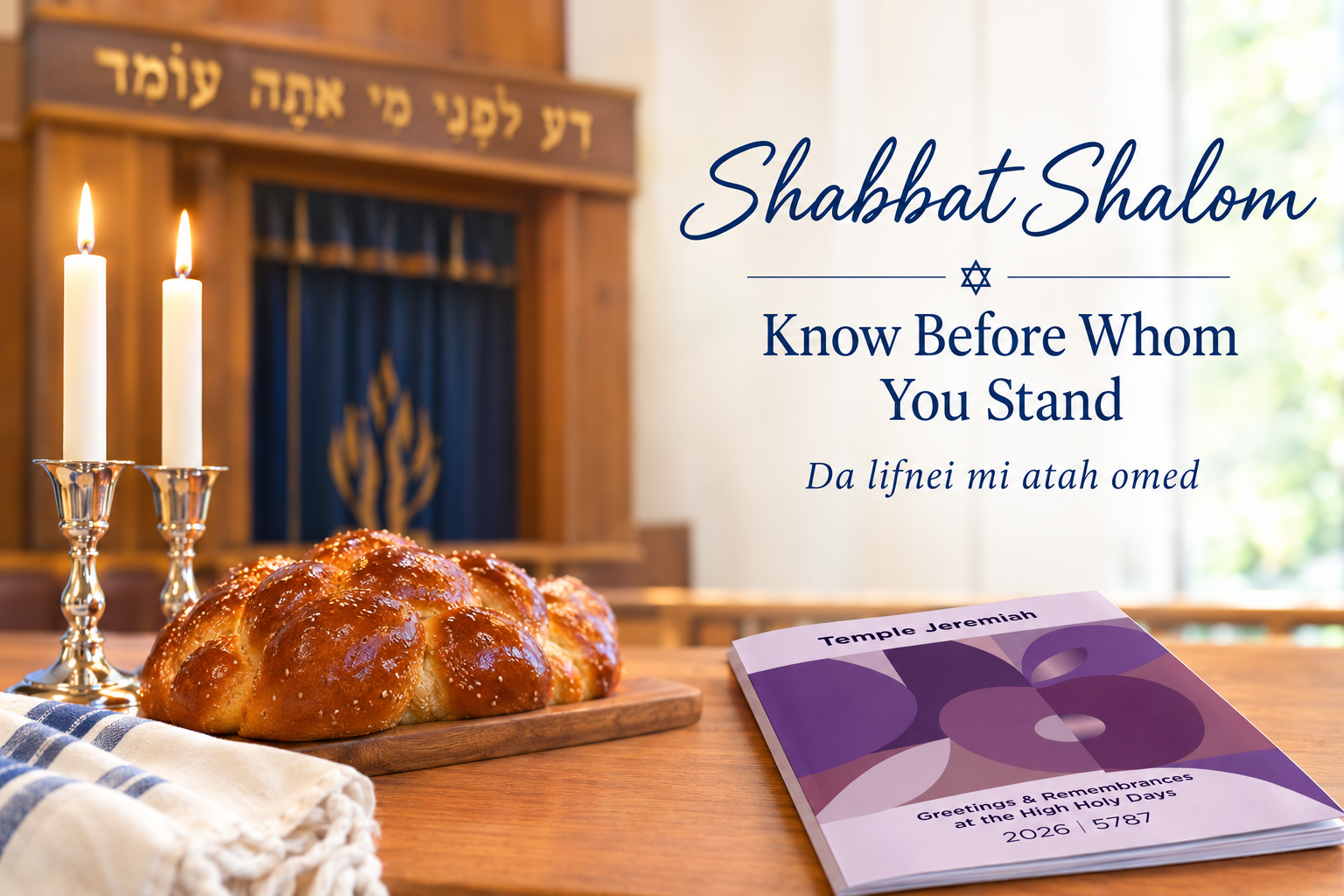
Da lifnei mi atah omed — "Know before whom you stand."
I grew up with these words. They were mounted in Hebrew above the ark in the sanctuary of the synagogue where I grew up.
I had not thought about this phrase for some time until it was introduced as our theme for this year at Jeremiah — and it opened a rush of memories.
I spent a lot of time contemplating those words, focused on the large, looming letters. I would translate the individual Hebrew words, but it took many years until I even began to understand the deep meaning they held.
I remember, as a seven- or eight-year-old, thinking the phrase was kind of silly. I always "knew" who I was standing before. I knew all the names of the kids in my classes, all the names of the kids on the street where I lived. Of course I knew before whom I stood.
But year in and year out, I began to think about the words far less literally.
Philosophically: is it really even possible to truly know another person?
Spiritually: what is my relationship with God? What do I owe God? What is my responsibility to community?
Practically: how do I hold myself out in the world — as a friend, as a daughter, as a student, and later as a professional?
These are not contrived memories. These words occupied a place in my thinking for many years, from childhood into early adulthood, and I believe they informed a lot of my thinking about why I so often choose to be in Jewish spaces, how I think about community, and how I approach my work.
It is certainly not a coincidence that most of my professional and volunteer life has been spent serving the Jewish community.
*
Every year, when I begin work on our Greetings and Remembrances Book, I find myself thinking about how it began.
When the pandemic closed our doors in 2020 and we could not gather in person for the High Holy Days, the idea for the Wishes Book took shape as a way to create connection, a way to greet one another when wishes for the new year could not be accompanied by an in-person hug or handshake. For me, it was a moment that community came alive.
So many of you filled out the form, sharing messages and photographs, and some of you even chose to share personal designs for the book, rather than the templates I had offered. I started to receive phone calls and emails from members, some I had not met previously but who instantly felt like family. People wanted to connect, to share how they were managing, to ask how everyone from the temple was doing.
The Wishes Book began as a way for us to come together from a distance, and it has grown into a Jeremiah tradition. Every year, we look for ways to make the book more meaningful and resonant: a new design, an inspiring reading, and a few years back, combining it with our Memorial Book, which led to the Greetings and Remembrances Book you know today.
Each summer, when the High Holy Days still seem months away, I send an email reminding you about the book, and so begins what makes this time of year so special for me — the season of connection.
Even a brief conversation to confirm the spelling of a name, or a gentle reminder that the deadline is near, carries warmth. Some conversations open into something more. A member will tell me about a loved one they are remembering, or share news of an upcoming celebration, and every so often, a conversation turns into a game of Jewish geography.
Occasionally, a member wants to share a greeting but is not quite sure how to put it into words, so we chat until something feels right.
And sometimes summer gets away from a family, and they reach out, worried they have missed the deadline. While I do not want to encourage you to make a habit of it, if the book has not yet gone to the printer, we always try to find a way to include an extra message, if not in the printed book, then in the digital copy that stays on our website all year.
There are also a few families who I know regularly share a greeting, so if I do not hear from them, I reach out – without fail, I have been met with gratitude for that extra reminder.
These conversations are a privilege of this work, and I appreciate each one.
I hope when you see the book this year, you take a moment with its pages, and feel the connections of joy and of memory they each hold.
My childhood self, looking up at the letters above the ark, would feel validated that part of knowing before whom you stand is knowing the names of everyone "in your neighborhood."
And my professional self is grateful for the opportunity to help build connection, page by page, name by name, one conversation at a time, with humility and gratitude.
I hope you will take a moment to consider those words and contemplate how they may shape the way you hold yourself out in the world: in your Jewish life, relationships, work, and community.
Wishing you all a beautiful Shabbat, a meaningful Yom Kippur, and a sweet year filled with connection and community.
L'Shanah Tovah and Shabbat Shalom,
Leslie